From Friction to Flow
The First Law of Thermodynamics: energy is never created or destroyed. It only changes form. The energy your organization loses to rework, spinning, and throwaway work doesn't disappear. It becomes heat. Friction. And that friction — becomes the gap between strategy and realized value.
Do a search for why transformations fail, and you'll see a common pattern. Somewhere between 65% and 88% of transformation programs fail to achieve their intended value. The energy went somewhere — it became heat and friction.
Let's unpack it.
Most projects start with requirements, a budget, or resources. If you have project goals and actionable metrics aligned to enterprise strategies and north stars you're increasing your odds of achieving your intended value.
Now imagine if your transformation also accounted for all the tectonic plates in the ecosystem that are moving against that vision — each one with its own rationale, each one optimizing for their piece of the terrain, each one adding to the fault line that could cause the next earthquake or tipping point. The reorg. The failed transformation. The initiative that slides downhill taking everything with it.
By accounting for this energy — you're designing with the forces not against them. That's where intended value is delivered. Traditional change management tries to shape where the energy goes — through communications plans, training programs, adoption metrics, compliance checklists. It assumes that if you push hard enough the energy will follow. Terrain design shapes where it flows naturally.
Let's play this out.
The delivery team knows the solution won't work. The knowledge has nowhere to go. It becomes heat — frustration, silence, disconnect. The project proceeds. The waste compounds.
Those are the heat maps of a Transactional Business Model. Take-make-dispose. More energy input. Less value output. The friction widens the gap with every cycle.
In a Sustainable Business Model, energy is recaptured instead of lost. There is ecosystem trust, guiding principles, and a shared DNA. Rework is measured. Insights circulate. Friction becomes feedback. Project goals and actionable metrics are tied to enterprise strategy. Each sprint is authentically better than the last one.
In a Regenerative Business Model energy is deliberately recaptured and returned to the cycle. Silos break down. Retrospectives are truly valued. The system is actually designed to fail small and fast without accumulating debt. The feedback loop is embedded. Insights are valued and respected and reach design teams before the build begins. The energy that was friction becomes new value streams and innovation.
In an Evolved Business Model energy compounds. The system becomes self-correcting. Insights don't just improve the next build — they redesign the terrain so future builds need less energy. The gap between strategy and realized value closes because the system was designed to circulate intelligence and value at every node. It continually simplifies growth and delivers multiplied ecosystem value.
It plays out as connective tissue across every dimension simultaneously. Profit. People. Planet. Purpose. Experience.
In a Transactional model the energy flowing through each dimension becomes heat — cost, frustration, liability, noise, friction. In a Regenerative model that same energy circulates back into the ecosystem — net positive value, empowerment, restoration, purpose, connection.
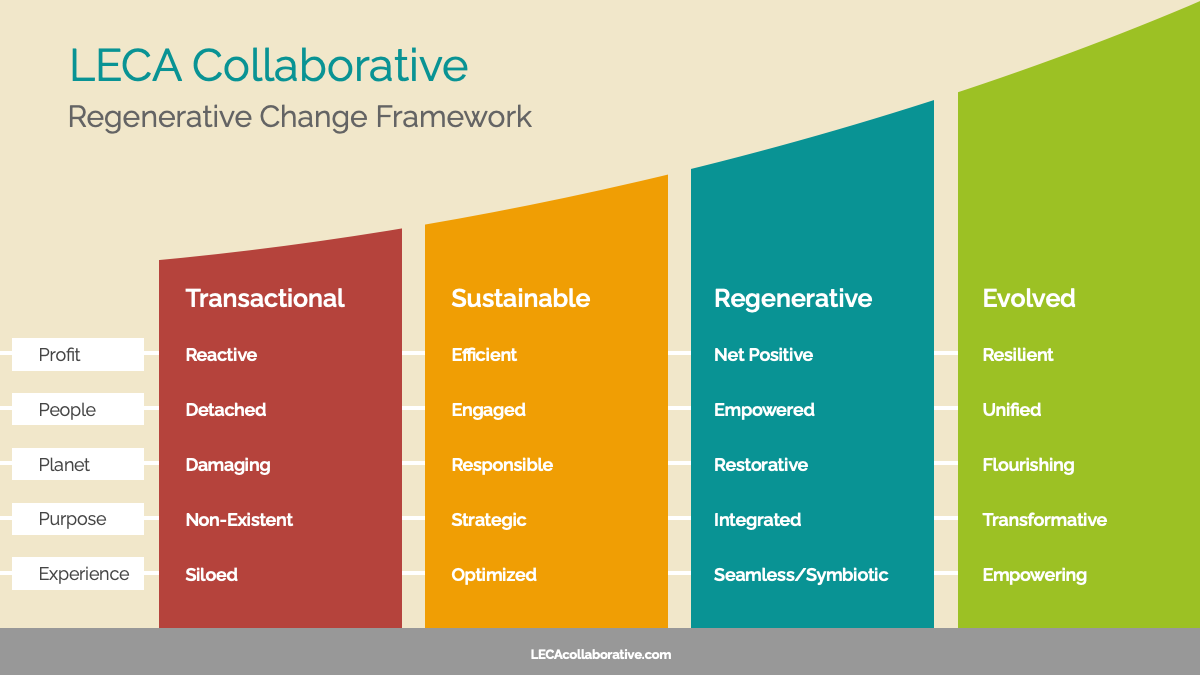
Here's the map.
LECA Collaborative’s Regenerative Change Framework. Four stages of organizational maturity across five dimensions.
Read it as columns — where are you on each dimension right now?
Read it as rows — what does each stage require across all five simultaneously?
Pick one dimension — where are you today? What would it take to move one stage to the right?
That's your terrain test this week. Don't just manage transformation. Design the terrain between where your organization is and where it needs to go — working with the energy and forces not against them.
How are you simplifying growth?
I build the operating system between strategy and execution. If this lands — reach out. That's usually where the best conversations start.